Have Mercy: Following Jesus in Politically Challenging Times Part 5
Opening Prayer
All things come from you, O God, and to you we return. All things emerge in your great river of life and into you we vanish again. At the beginning of this day we wake, not as separate streams but as countless currents in a single flow, the flow of this day’s dawning, the flow of this day’s delight, the flow of this day’s sorrows, your flow, O God, in the twistings and turnings of this new day.
- John Philip Newell, Praying with the Earth – A Prayerbook for Peace, p. 26.
Have Mercy: Following Jesus in Politically Challenging Times -
Encouragement to bear courageous witness rooted in the Gospel. An invitation to consider together how core Gospel commitments such as loving our neighbor, welcoming the stranger, and telling the truth can shape faithful Christian discipleship in today's political climate.
“Power Over” or “Power With”
The Empire’s Power –
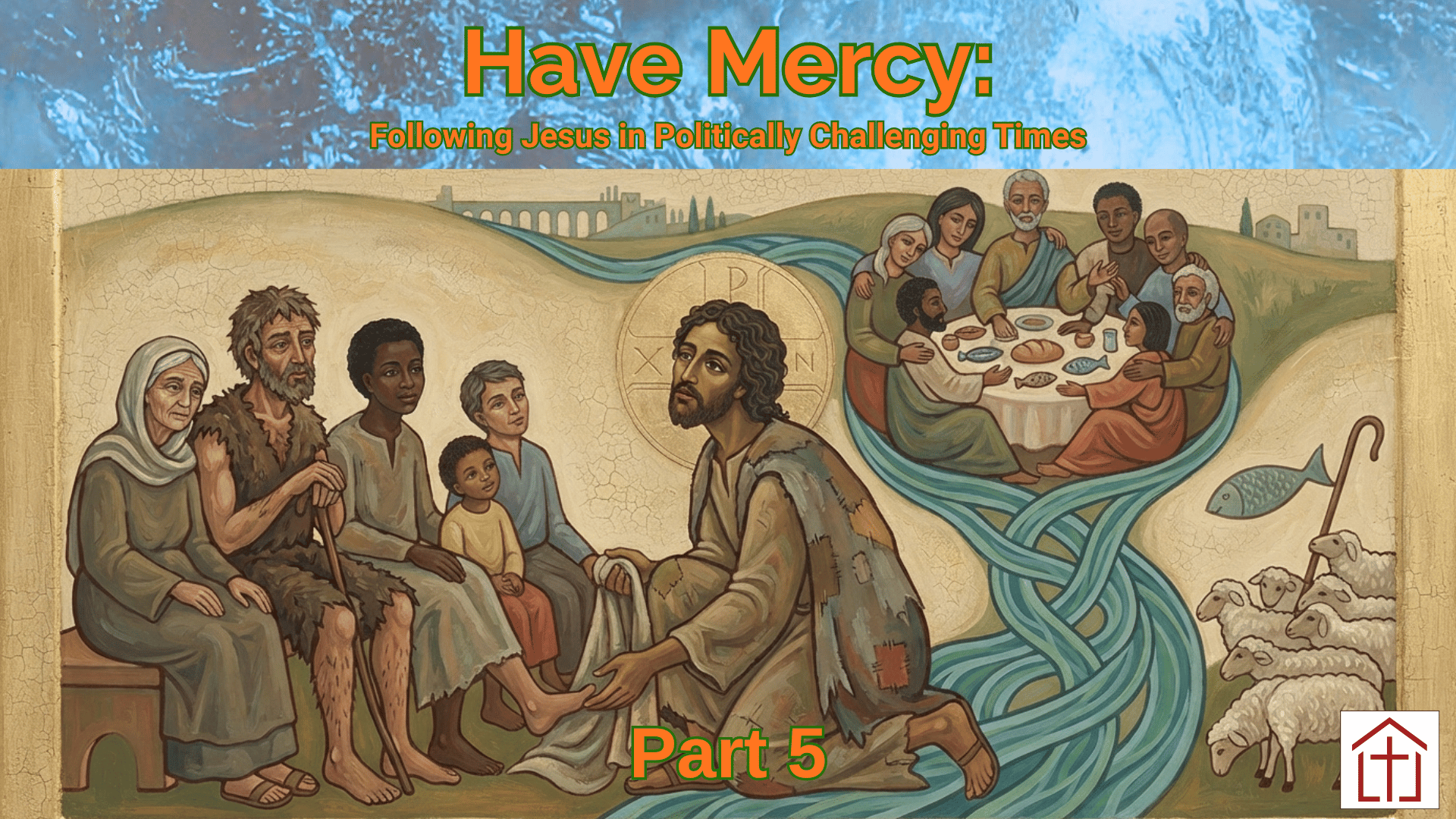
There were different understandings of power held by the early Jesus movement and the Roman Empire. “The historical reality of Christian empire, like Christian anti-Semitism, is bathed in irony. Jesus was an oppressed brown Palestinian Jew, living in a Middle Eastern nation that was occupied by a European empire centered in Rome. Jesus challenged the empire of Rome by proclaiming an alternative empire, the empire [Kingdom] of God. The similarity of the terms highlighted the radical contrasts between the two empires:
- Rome’s empire was violent. God’s empire was non-violent.
- Rome’s empire was characterized by domination. God’s empire was characterized by service and liberation.
- Rome’s empire was preoccupied with money. God’s empire was preoccupied with generosity and was deeply suspicious of money.
- Rome’s empire was fueled by love of power. God’s empire was fueled by the power of love.
- Rome’s empire created a domination pyramid that put a powerful and violent man on the top, with chains of command and submission that put everyone else in their place beneath the supreme leader. God’s empire created a network of solidarity and mutuality that turned conventional pyramids upside down and gave ‘the last, the least, and the lost’ the honored place at the table.”
“Not surprisingly, the Roman Empire saw Jesus and his nonviolent movement as a threat to their
violent regime, so they had him tortured and publicly executed as a matter of standard procedure. By pinning a naked human being to wood . . . the empire showed its own absolute dominance and its victim’s absolute defeat. The message was clear: Jesus’ message of truth and love meant nothing in the face of the empire’s crushing power and domination.”
“Echoing its founder’s nonviolence, the Christian faith initially grew as a nonviolent spiritual movement of counter-imperial values. It promoted love, not war. Its primal creed elevated solidarity, not oppression and exclusion: ‘For in Christ Jesus you are all children of God through faith. As many of you as were baptized into Christ have clothed yourselves with Christ. There is no longer Jew or Greek, there is no longer slave or free, there is no longer male and female; for all of you are one in Christ Jesus’ (Galatians 3:26-28).”
“The early Christians elevated the equality of friendship rather than the supremacy of hierarchy
(John 15:15; 3 John 14, 15). Because of their counter-imperial posture, including their refusal to be soldiers in the Roman army or to participate in the imperial cult that proclaimed the divinity of the emperor, they were often mocked, distrusted as unpatriotic, and persecuted.”
“Since Constantine (early 4th century), Christianity has repeatedly claimed a legitimate right to do violence to its members [and others] to protect its interests and conserve its supremacy. It has sought far-reaching and sometimes almost limitless control over the behavior and minds of its subjects. At times, it has behaved like a totalitarian power, suppressing dissent and claiming divine and absolute authority, capable of absolute corruption.”
(Excerpts from Brian D. McLaren, Do I Stay Christian? A Guide for the Doubters, the Disappointed, and the Disillusioned.)
“[The Apostle Paul] was a complicated figure, toggling between supporting empire and resisting it. He wasn’t fully aligned with the imperial structures, but he also wasn’t entirely outside them. His writings reveal both a longing for liberation and dutiful adherence to the constraints of his world. To engage Paul’s work with honesty is to resist the urge to reduce him to either a revolutionary or a mere enforcer of empire, recognizing instead a man shaped by both revelation and limitation. Paul’s teachings about the role of women in the early churches reflects this tension.”
“Perhaps the most powerful challenge to the imperial order comes in Galatians 3:28, where Paul declares that in Christ there is no male or female, no slave or free – a radical vision that upends the social hierarchies of his time. If the household is a microcosm of the state, what kind of world might take shape if families lived as if this were true? [See Ephesians 5:21 – mutual submission.] It would be something unrecognizable to Rome, something that threatened the very foundations of its rule.”
“[Paul’s] teachings suggest a kind of shared power within the family – a power-with not a power-over. Power-with is mutual. It requires listening, respecting, and honoring the dignity of each person, no matter their age or status. Power-with creates a culture of empathy and co-operation, not domination through fear or force.”
(Excerpts from Kat Armas, Liturgies for Resisting Empire, Seeking Community, Belonging, and Peace in a Dehumanizing World.)
For this week: For reflection: Are you willing to consider your deep reflections on politics as part and parcel of our spiritual call?
An invitation to our virtual participants: Discussion and comments are very much encouraged and welcomed. Online discussions can be held in the comments section in the upcoming post on Social Media for this week’s Deacon’s Reflection which is part of adult formation at St. Francis Episcopal Church.
Closing Prayer – Prayer of Blessing
On this day the blessings of heaven. On this day the blessings of earth. On this day the blessings of sea and of sky. To open us to life, to ground us in life, to fill us with life and with wonder. On those we love this day and on every human family, the blessings of heaven, the blessings of earth, the blessings of sea and of sky.
May the light of God illumine the heart of my soul.
May the flame of Christ kindle me to love.
May the fire of the Spirit free me to live this day, tonight, and forever. Amen.
- John Philip Newell, Praying with the Earth - A Prayerbook for Peace, p. 12.
Have Mercy: Following Jesus in Politically Challenging Times,” Deacon Joe Dzugan, St. Francis Episcopal Church, 2026.