Opening Prayer
Light within all light, Soul behind all souls, at the breaking of the dawn, at the coming of the day, we wait and watch. Your light within the morning light, Your soul within the human soul, Your presence beckoning to us from the heart of life. In the dawning of this day, let us know fresh shinings in our soul. In the growing colors of new beginnings all around us, let us know the first lights of our heart. Great Star of the morning, Inner Flame of the universe, let us be a color in this new dawning.
- John Philip Newell, Praying with the Earth – A Prayerbook for Peace, p. 2.
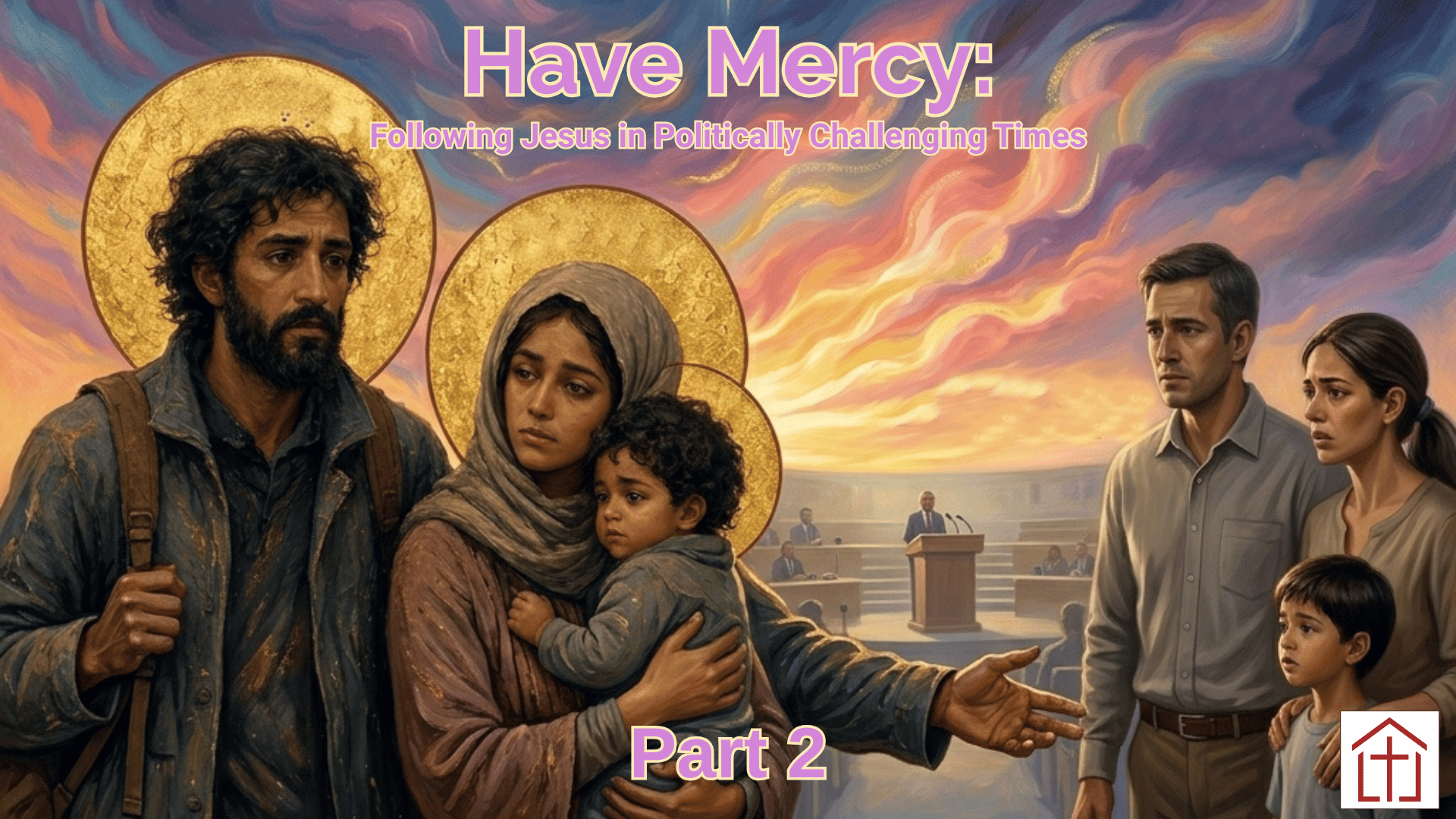
Have Mercy: Following Jesus in Politically Challenging Times -
Encouragement to bear courageous witness rooted in the Gospel. An invitation to consider together how core Gospel commitments such as loving our neighbor, welcoming the stranger, and telling the truth can shape faithful Christian discipleship in today's political climate.
“Definition” of Mercy
Perhaps “mercy” can best be described as intertwined righteousness and love.
Mercy expresses God’s goodness and love for the guilty and miserable. It includes pity, compassion, gentleness, and forbearance. God’s mercy is both free (not required by outward restraint) and absolute (covering all areas of human life). God’s mercy to humans requires mercy on humans’ part (Matt. 18:23-35).
The Old Testament word for mercy is hesed, which includes the idea of steadfast love. New Testament words are eleos and oiktirmos (“pity,” “mercy,” “compassion”). The prevailing Septuagint (LXX) rendering of hesed, eleos, and a somewhat frequent dikaiosyne (“righteousness”) suggest an intimate relationship between these two attributes. Apparently, no one Greek term was adequate to convey the word’s full idea of intertwined righteousness and love.
(Baker’s Dictionary of Theology)
Showing Mercy - A Reflection from The Rt. Rev.Mariann Budde, Bishop, Epicopal Diocese of Washington
“Recently, the Diocese of Washington held our annual convention. In the afternoon, we debated a resolution entitled ‘Dignity, Not Hate, Not Mass Deportation, Not Silence,” a strong call for the congregations in the Diocese of Washington to take up the cause of migrants in our communities, with a list of prescribed actions for congregants to take.”
“I had no doubt that the resolution would pass. Nonetheless, those who came to the microphone to support it spoke as if they were at an outdoor rally, tasked with whipping up the crowd; or perhaps on the debate floor with hostile adversaries on the other side. No one spoke against the resolution, and I wasn’t surprised.”
“I have served the Diocese of Washington for fifteen years. I know and love people who hold a different view from the one being espoused; I was certain that many were on the convention floor. There were even more, I was convinced, sympathetic to the resolution, but nonetheless uncomfortable with the strident tone of those putting it forward, the blanket statements made, and the sense of moral superiority in the room.”
“I was uncomfortable precisely because there was no mercy for those who held a different view or were uncertain. No one spoke in opposition because it wasn’t a welcome space to do so.”
“We failed to show mercy as we argued for the mercy that migrants rightfully deserve. It is a painful lesson that I take with me.”
“The politics of mercy is not a substitute for justice, but it does soften it. Mercy doesn’t erase accountability, but it does make room for our humanity. Mercy is a discipline that requires self-awareness, proximity, and a commitment to stay in relationship when retreating into our safe corners would be easier.”
“For Christians, the question is not whether mercy belongs in public life, but whether we have the imagination and courage to practice it in whatever realm we find ourselves in – not for ourselves alone, but for the common good. I’m grateful to be able to talk about mercy, as a practitioner with my own ups and downs, knowing that it is through practice that we grow.”
“May we remember that mercy others need is also what we ourselves long for, and that we all stand equidistant under the mercy of God.”
Theology in Politically Challenging Times
“The call to have mercy, stands within scriptural, liturgical, and spiritual tradition. God is merciful, and therefore we can have mercy on others. And here is the further [controversial] claim: in showing mercy, we are acting politically; we are engaging in politics. This is a central argument, but it is controversial. The frequently made assertion that the church ought to stay out of politics has gathered urgency in recent times with the rise of Christian nationalism. Christian nationalism advocates the use of all the tools of governance, including legal sanction and violence, to enact a particular theological vision. In a rather circular logic, Christian nationalists place the nation, rather than God, at the center of their worship and use the power of the state to enact their theological vision. At root, the problem is idolatry: Christian nationalists place the nation above God, and that false worship creates the conditions for violence against fellow citizens, the poor, the immigrant, and many, many other groups. Christian nationalists engage in politics in ways that distort the Christian faith and do harm to the common good.”
“Given this theological error, it might be tempting to say, ‘Let’s just get theology out of our politics altogether.’ And this is the temptation on the other side: to remove theology completely from the public square. But this is problematic, too, for both political and theological reasons.”
(Ruthanna B. Hooke, Kyle B. T. Lambelet, and Altagracia Perez-Bullard, editors, Have Mercy, 2026.)
For this week: For reflection: When have you seen connections between your spirituality and your public life?
An invitation to our virtual participants: Discussion and comments are very much encouraged and welcomed. Online discussions can be held in the comments section in the upcoming post on Social Media for this week’s Deacon’s Reflection which is part of adult formation at St. Francis Episcopal Church.
Closing Prayer – Prayer of Blessing
May the light of God illumine the heart of my soul.
May the flame of Christ kindle me to love.
May the fire of the Spirit free me to live this day, tonight, and forever. Amen.
- John Philip Newell, Celtic Benediction, p. 5.
Have Mercy: Following Jesus in Politically Challenging Times,” Deacon Joe Dzugan, St. Francis Episcopal Church, 2026.