Have Mercy: Following Jesus in Politically Challenging Times Part 4
Opening Prayer
It is in the depths of life that we find you, at the heart of this moment, at the center of our soul, deep in the earth and its eternal stirrings. You are the Ground of all being, the Well-Spring of time, Womb of the earth, the Seed-Force of stars. And so, at the opening of this day we wait, not for blessings from afar but for You, the very Soil of our soul, the early Freshness of morning, the first Breath of day.
- John Philip Newell, Praying with the Earth – A Prayerbook for Peace, p. 18.
Have Mercy: Following Jesus in Politically Challenging Times -
Encouragement to bear courageous witness rooted in the Gospel. An invitation to consider together how core Gospel commitments such as loving our neighbor, welcoming the stranger, and telling the truth can shape faithful Christian discipleship in today's political climate.
Quote of the Week
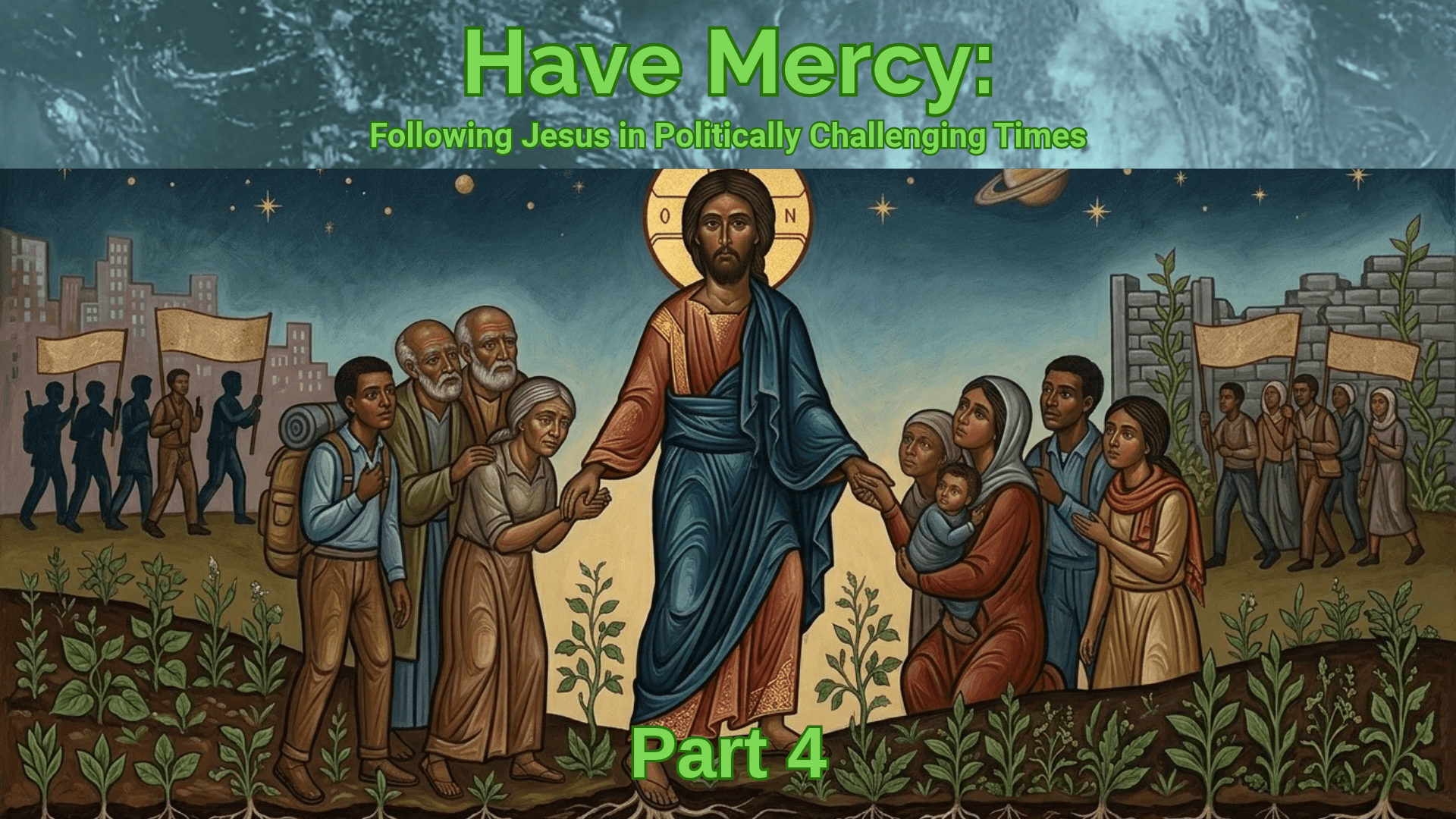
"Humanity is endowed with both benevolence and wickedness. Without nurturing benevolence, wicked aspects of human nature will dominate to the point where people consider no method too base and no sin too evil." Also, this: "Ethics and wisdom are cultivated. Leaving a garden untended will cause an overgrowth of weeds."
- Courtesy of Betty Barry
Theology in Politically Challenging Times (cont’d)
“Bishop Budde’s witness demonstrated that we do not have to choose between the false choice of Christian nationalism on the one hand and secular evacuation of the public sphere on the other. In her call
to the president to ‘have mercy,’ she was engaging in political action. However, in doing so, she was proclaiming that Christians need not engage in politics in the way that the world does politics. The call to ‘have mercy’ points to the fact that Jesus’ message is political in a particular way, in a way that puts mercy at the center. Jesus announced a reign that had no military, maintained unclear borders, and turned conventional values upside down. He called for compassion, even for the enemies, as a fundamental way of living. He preached a politics that attends to the least of these, placing the margins at the center. He modeled a politics that confronts our dominant perceptions of worth and value. But most of all, in centering mercy, Jesus demonstrated and invites his followers into a politics that is incarnational. We must, as Pope Francis encouraged, look the poor in the eye and touch their hand when we give them alms. The plea to have mercy, to practice the works of mercy, is not merely spiritual. It is also political. The politics of mercy are fleshy, incarnational, personal, gritty, joyful, and life-giving.”
“Some might object that mercy is not a fitting goal for Christian political action, which should be pursuing justice more than mercy. Politics, on this account, should be ordered to justice rather than mercy, power rather than love. However, it is precisely the dynamics of power that are intrinsic in mercy that makes this quality so fitting for a Christian politics. That mercy is in the first instance an attribute of God alerts us that an imbalance of power is inherent in the exercise of mercy. Our cry to God to have mercy on us is the cry of those with less power to one who is omnipotent. God, being so much more powerful that we are, relates to us by showing us mercy. Likewise, when Bishop Budde asked President Trump to have mercy, she was drawing attention to his awesome power over many, many others. Bishop Budde could have called on President Trump to heed Jesus’ description of the two great commandments – to love God
and neighbor – but instead she called on him to have mercy. Mercy can be distinguished from love in that mercy is about compassion and consideration shown by the powerful to those who have less power. The plea to ‘have mercy’ is a plea to those in power to use their power with compassion. Perhaps this is why Bishop Budde’s demand that the president ‘have mercy’ was particularly unsettling to him, since it was in effect a reminder of the power he had and of his responsibility to use it morally. After all the pomp of the inauguration, he was no doubt fully aware of his power, but the bishop’s sermon was a discomfiting reminder that power comes with certain moral demands.”
“It is in part the power imbalance inherent in mercy that can make people uncomfortable with the call to mercy as a governing value of politics and is at the root of the sense that politics ought to be more about justice than mercy. Inasmuch as our common life is made up of people who have different degrees of power, mercy is a way of acting in our common life that rebalances these imbalances of power. Mercy, as distinct from pity, is showing compassion for and standing in solidarity with the disempowered. And since God’s gracious mercy is fundamental, at the heart of God’s creation of everything that is and God’s ongoing relationship to it, mercy is not a nice addition to the core reality of the world. Rather, for Christians, mercy must be a guiding force in our politics.”
“We see, in times like our own, that the basics of Gospel work – preaching the good news of Jesus, caring for the poor and the stranger, healing the sick and the outcast, telling the truth, even if through a parable – have radical political implications. Moreover, these actions go beyond the classic understanding of the ‘works of mercy,’ and flow into advocacy for social transformation, a more equitable distribution of goods, and the establishment of structures and policies that truly advance the common good. When Bishop Budde asked newly inaugurated President Trump to have mercy in January 2025, she summoned him and all those listening to pursue this vision of our common life. What she asked was not unusual in the long history of God’s people. But it took on a radical edge due to the change in political context. The powerful witness of Bishop Budde was a reminder to us that Christians don’t have to choose between Christian nationalism on the one hand and withdrawal from the public sphere on the other. There is Gospel work to do, even in this challenging political moment.”
(Ruthanna B. Hooke, Kyle B. T. Lambelet, and Altagracia Perez-Bullard, editors, Have Mercy, 2026.)
For this week: For reflection: When have you seen connections between your spirituality and your public life?
An invitation to our virtual participants: Discussion and comments are very much encouraged and welcomed. Online discussions can be held in the comments section in the upcoming post on Social Media for this week’s Deacon’s Reflection which is part of adult formation at St. Francis Episcopal Church.
Closing Prayer – Prayer of Blessing
On this day the blessings of heaven. On this day the blessings of earth. On this day the blessings of sea and of sky. To open us to life, to ground us in life, to fill us with life and with wonder. On those we love this day and on every human family, the blessings of heaven, the blessings of earth, the blessings of sea and of sky.
May the light of God illumine the heart of my soul.
May the flame of Christ kindle me to love.
May the fire of the Spirit free me to live this day, tonight, and forever. Amen.
- John Philip Newell, Praying with the Earth - A Prayerbook for Peace, p. 12.
Have Mercy: Following Jesus in Politically Challenging Times,” Deacon Joe Dzugan, St. Francis Episcopal Church, 2026.