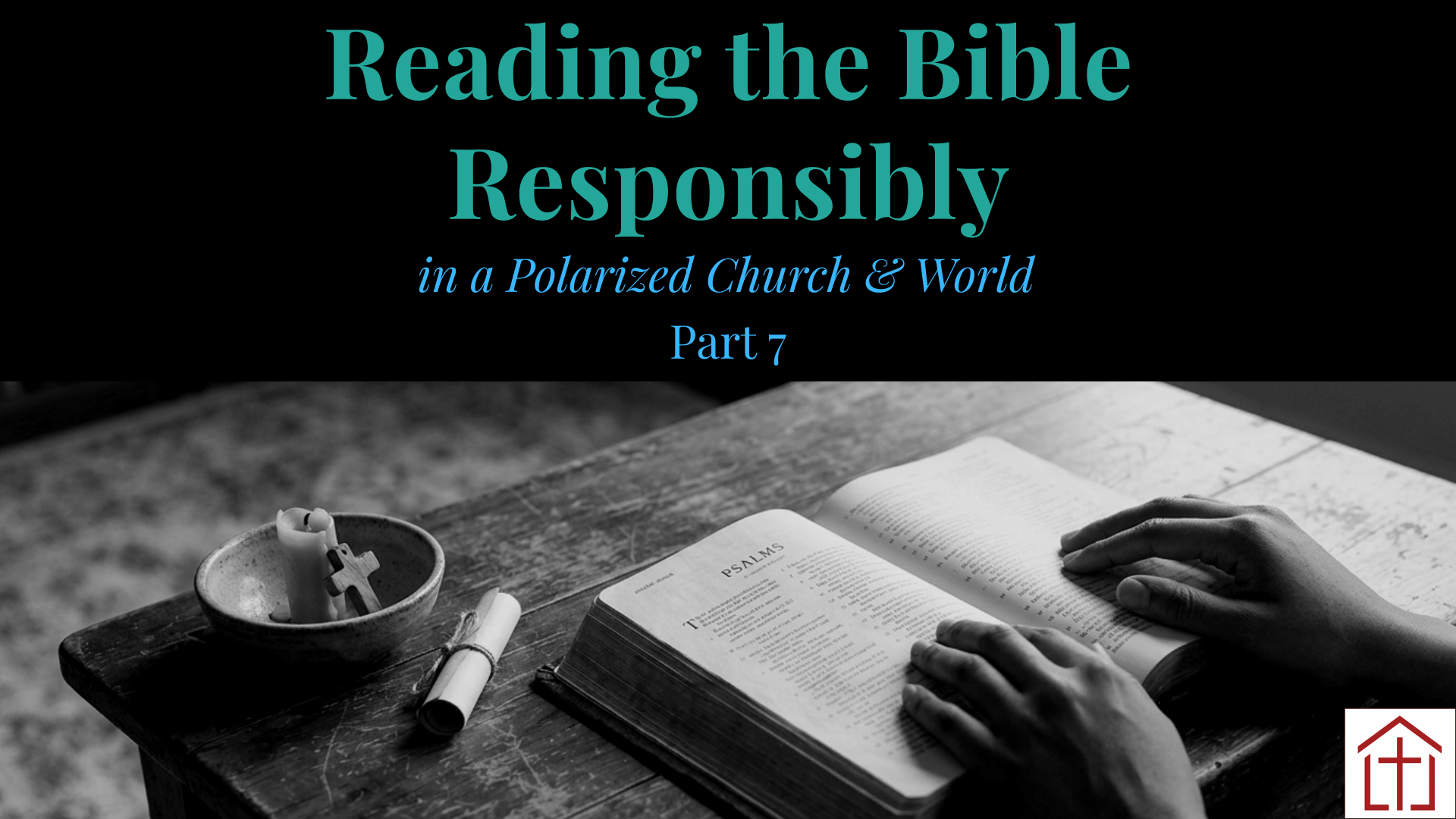
Reading the Bible Responsibly in a Polarized Church & World – Part 7
Opening Prayer
In the silence of the early morning, your Spirit hovers over the brink of the day, and new light pierces the darkness of the night. In the silence of the morning, life begins to stir around me, and I listen for the day’s first utterances. In earth, sea, and sky, and in the landscape of my own soul, I listen for utterances of your love, O God. I listen for the utterances of your love.
- John Philip Newell, Celtic Benediction, p. 74.
Reading the Bible Responsibly in a Polarized Church & World:
The Bible’s content in many ways engages its readers – puzzling, angering, challenging, and inspiring them. How has the Bible historically been used, including with the issue of slavery? Can readers navigate the use of biblical texts that are quoted across the political spectrum? What principles exist for interpreting these texts that support conflicting viewpoints? Together, we will explore a way forward: reading the Bible with each other, guided by the rule of love.
Questions and Answers
What is the Origin of Lectio Divina?
This tradition of prayer flows out of a Hebrew method of studying the scriptures, which was an interactive interpretation of the scriptures by means of the free use of the text to explore its inner meaning. It was part of the devotional practice of the Jews in the days of Jesus.
There are several approaches to Lectio Divina (Sacred Reading) with different origins. The monastic form of Lectio Divina is an ancient method that was practiced by the Mothers and Fathers of the Desert and later in monasteries both East and West. The monastic way is unstructured. One listens to the word of God in a particular passage chosen for the occasion, and then one follows the attraction of the Spirit. There could be different “moments” in this approach. This method can also be prayed in a group.
The scholastic form of Lectio Divina developed in the Middle Ages at the beginning of the Scholastic Period. At this time, there began a tendency to compartmentalize the spiritual life. As this tendency grew, the emphasis was placed more upon rational analysis and less on personal experience. The scholastic form divides the process into stages or steps in a hierarchical pattern. The scholastic method may be practiced privately or in a group.
What Scripture “Writings” Were Available to Origen of Alexandria (185-253 CE)?
By the end of the first century, all the New Testament writings were in existence. But the 27 New Testament writings did not yet exist as a completed collection. The canon of Scripture formed over time, most significantly between the second and fourth centuries. Origen knew and used all 27 books of the New Testament. Origen’s writings included extensive biblical exegesis covering a large number of books of the Bible, including John, Matthew, and Genesis, often focusing on allegorical or ‘hidden” meanings.
The Bible and Racism in the United States
“Both slavery and Christianity were essential parts of American society from its beginning. While most Americans learn in school that the ‘Pilgrims’ landed on Plymouth Rock in 1620, in order to seek religious freedom in the New World, we are not [typically] taught that the year before (1619), the first African slaves were brought to America in Jamestown, Virginia. The beginning of abolitionism in both England and the United States began in the late 1700s and had religious roots, with Quakers being among the first groups to call for an end to slavery. By 1840, chattel slavery (the practice of owning, buying, and selling human beings as property) had been abolished in the British Empire, French colonies, and the Papal States, but it would take another quarter century and the bloodiest war in its history for the United States to finally bring it to an end, although the Civil War did not end the systemic racism and White privilege in
America by any means. From the first part of the 1800s all the way up to the beginning of the war, clergy, politicians, and activists engaged in heated debate about the morality of slavery. Naturally, they used the Bible both to attack their opponents’ position and to support their own.”
“The arrival of the first enslaved Africans at Jamestown in 1619 raises the question of how Christianity did and did not speak to their condition in the American colonies. As [author] Albert Raboteau details in his history of Christianity among enslaved Africans and their descendants, White Christians were not eager to evangelize the enslaved, because ‘the economic profitability of his slaves, not their Christianization, held top priority for the colonial planter.’ However, the Second Great Awakening, which began in the late 1700s and continued throughout the first part of the 1800s, led to many of the enslaved becoming Christians, especially due to the missionary efforts by Baptists and Methodists. The evangelical fervor of the Great Awakening meant that conversion was not about intellectual assent to a creed, but rather the result of an intense personal experience of the Almighty that left the person changed. Part of what appealed to the enslaved (and made slave owners uncomfortable) was Evangelical Christianity’s emphasis on the equality of believers before God. Before long, Southern states would pass laws outlawing Black ministers or Black literacy. Even the American Bible Society followed these rules and did not extend to the enslaved its mission of providing the Bible to every American family.”
(Thomas M. Bolin, An Inspired Word in Season – Reading the Bible Responsibly in a Polarized World, 2025.)
For this week: For reflection: Do you remember being taught in school that the first African slaves were brought to America in Jamestown, Virginia, in 1619?
An invitation to our virtual participants: Discussion and comments are very much encouraged and welcomed. Online discussions can be held in the comments section in the upcoming post on Social Media for this week’s Deacon’s Reflection, which is part of adult formation at St. Francis Episcopal Church.
Some Suggested Study Resources:
- The New Oxford Annotated Bible, NRSV, with the Apocrypha; 5 th edition.
- The Harper Collins Study Bible, NRSV, Fully Revised and Updated (Including Apocryphal
Deuterocanonical Books); Society of Biblical Literature; (e-book). - The Jewish Annotated New Testament, NRSV, 2 nd edition, Amy-Jill Levine and Marc Zvi Brettler,
editors; Oxford University Press.
Closing Prayer – Prayer of Blessing
In the busyness of this day, grant me a stillness of seeing, O God. In the conflicting voices of my heart, grant me a calmness of hearing. Let my seeing and hearing, my words and actions, be rooted in a silent certainty of your presence. Let my passions for life and the longings for justice that stir within me be grounded in the experience of your stillness. Let my life be rooted in the ground of your peace, O God, let me be rooted in the depths of your peace.
May the light of God illumine the heart of my soul.
May the flame of Christ kindle me to love.
May the fire of the Spirit free me to live this day, tonight, and forever. Amen.
- John Philip Newell, Celtic Benediction, p. 77.
“Reading the Bible Responsibly in a Polarized Church & World,” Deacon Joe Dzugan, St. Francis Episcopal Church,
2026.