Reading the Bible Responsibly in a Polarized Church & World – Part 13
Opening Prayer
In the light of the high heavens and the infinity of dawnings in space, in the darkness of ocean depths and the sea’s ceaseless waves, in the glistening of a creature’s eyes and the dark life-blood that ever flows, in every emanation of creation’s life and the warmth that moves our bodies, in the inner universe of the soul and its everlasting foundations your glory glows, O God. In every shining of the world’s inwardness and the warmth that moves our everlasting soul your glory glows.
- John Philip Newell, Sounds of the Eternal – A Celtic Psalter, p. 62.
Reading the Bible Responsibly in a Polarized Church & World:
The Bible’s content in many ways engages its readers – puzzling, angering, challenging, and inspiring them. How has the Bible historically been used, including with the issue of slavery? Can readers navigate the use of biblical texts that are quoted across the political spectrum? What principles exist for interpreting these texts that support conflicting viewpoints? Together, we will explore a way forward: reading the Bible with each other guided by the rule of love.
Reading in the Kingdom of Love
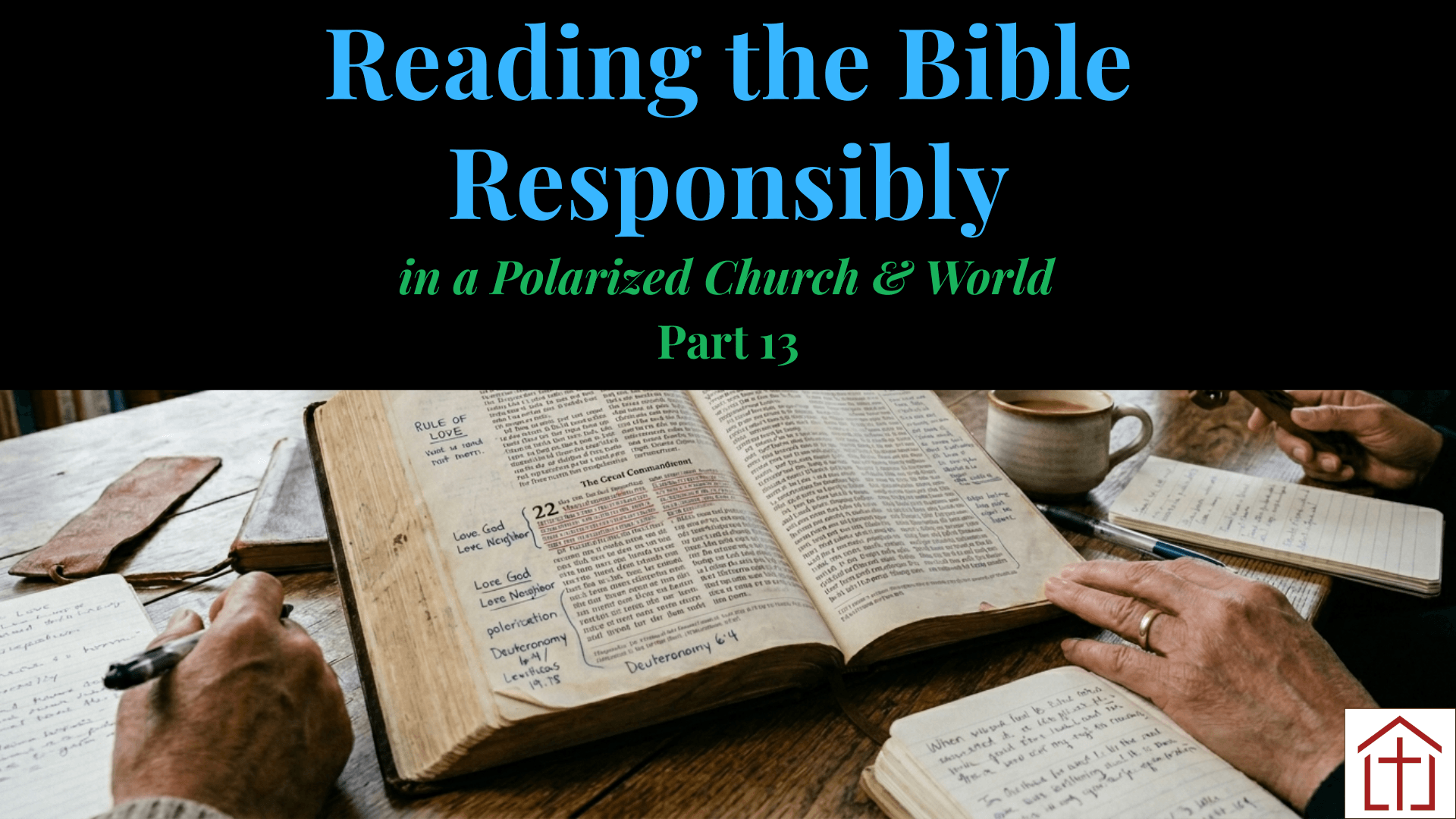
“One of the oldest Christian works on biblical interpretation is Augustine of Hippo’s On Christian Teaching (written sometime around 396 CE). Augustine articulates a method of biblical interpretation that has come to be known as the rule of love, inspired by Jesus’ teaching on the Great Commandment. Drawing on Augustine’s thought and the Gospel texts of the Great Commandment, [the author] articulates a particular standard of biblical interpretation that is sorely needed in this moment of polarization in the US church and society. [The author hopes that his] suggestion offers a way to bridge the chasm that separates members of the church and American Christians in general from each other when they meet over the Bible.”
“For Augustine, strictly speaking, the rule of love is that part of the rule of faith that is derived from the unambiguous parts of the Bible and set alongside the essential truths of the Christian faith handed down through tradition. In his search for the clearest part of the Bible that articulates the essence of faith, Augustine uses Jesus as his model reader and looks to the story of the Great Commandment (Matt. 22:34-40); Mark 12:28-34; Luke 10:25-37). In this story, Jesus is approached by a scholar of the law, and expert in the biblical text, specifically the Pentateuch, who ask Jesus to name the greatest of all the commandments. The scholar’s question understands the text to be communication, telling the reader’s something God wants them to do. In response to the scholar’s question, Jesus responds with two commandments: a person should love God with all their heart, soul, mind, and strength (Deuteronomy 6:4) and love their neighbor as themselves (Leviticus 19:18). Because Jesus identified these two texts out of the entire biblical corpus as the greatest, Augustine will assert that the entire moral teaching of the Bible is love of God and love of neighbor, ‘the rule of love that God has set for us’ (On Christian Teaching).”
“I want to reiterate that Augustine doesn’t set this reading strategy alongside others. Rather, it is the fundamental assumption that one must bring to their reading of the Bible and the essential criterion by which one judges every interpretation of every biblical text: ‘So if it seems to you that you have understood the divine scriptures, or any part of them, in such a way that by this understanding you do not build up this twin love of God and neighbor, then you have not yet understood them. (On Christian Teaching). As
someone who read the biblical texts allegorically, Augustine uses the rule of love as the interpretative lens to determine which biblical passages are to be read literally or metaphorically.”
“Augustine realizes that this is no easy task. Like many other Christian readers in antiquity, he understood the Bible’s sacred status to imply also that it was a book of deep wisdom that would be difficult to interpret. But the mercy of God also provided for clear parts of the text to help those who were not yet ready for the more arcane parts of the Bible. In his own stunning use of metaphor, Augustine exhorts his readers ‘to take pains to turn over and over in your mind what you read, until your interpretation of it is led right through to the kingdom of love’ (On Christian Teaching).”
“Augustine’s rule of love demands that every biblical reading support either love of God or neighbor, no matter how much interpretative work that requires. Furthermore, love of God and of neighbor, although two separate commandments, are both realized in the love of other human beings given that God is most clearly imaged in the human person by both virtue of creation and the incarnation of Jesus. Love of neighbor entails the restoration of the fundamental human unity that has been broken by unjust social and economic structures, nationalism, racism, and religious intolerance. The Bible’s fundamental moral call, according to the rule of love, is to respond to these instances of fragmentation and to seek a restoration of the wholeness insofar as we are able to in our own historical milieu.”
(Thomas M. Bolin, An Inspired Word in Season – Reading the Bible Responsibly in a Polarized World, 2025.)
For this week: For reflection: What does the “rule of love” mean for you and how is it realized in your life?
An invitation to our virtual participants: Discussion and comments are very much encouraged and welcomed. Online discussions can be held in the comments section in the upcoming post on Social Media for this week’s Deacon’s Reflection which is part of adult formation at St. Francis Episcopal Church.
Some Suggested Study Resources:
- The New Oxford Annotated Bible, NRSV, with the Apocrypha; 5th edition.
- The Harper Collins Study Bible, NRSV, Fully Revised and Updated (Including Apocryphal Deuterocanonical Books); Society of Biblical Literature; (e-book).
- The Jewish Annotated New Testament, NRSV, 2nd edition, Amy-Jill Levine and Marc Zvi Brettler, editors; Oxford University Press.
Closing Prayer – Prayer of Blessing
That your glory rises in the morning sun and sparkles off flowing waters, that the glory of the everla,sting world shines in this world growing from the ground and issuing forth in every creature, that glory can be handled, seen, and known in the matter of earth and human relationship and in the most ordinary matters of daily life, assure us again this day, O God, assure us again this day.
May the light of God illumine the heart of my soul.
May the flame of Christ kindle me to love.
May the fire of the Spirit free me to live this day, tonight, and forever. Amen.
- John Philip Newell, Sounds of the Eternal – A Celtic Psalter, p. 65.
“Reading the Bible Responsibly in a Polarized Church & World,” Deacon Joe Dzugan, St. Francis Episcopal Church,
2026.