Are These Really The End Times? – Exploring The Book of Revelation Artistically – Part 12
Opening Prayer
For your goodness, O God, boundless and everlasting, thanks be to you. For your generosity, gracious and wise, thanks be to you. For your mercy, strong and free, thanks be to you. Let us share your goodness. Let us practice your generosity. Let us live your mercy that we and the world may be well.
- J. Philip Newell, Celtic Treasure – Songs of the Soul, p. 164.
Are These Really The End Times? – Exploring The Book of Revelation Artistically:
The Book of Revelation is the strangest book in the Bible – and the most controversial. Instead of stories and moral teaching, it offers only visions – dreams and nightmares. These sessions are for all who seek to move beyond the quest to decode this book with plain answers and find an alternate way to navigate the Book of Revelation.
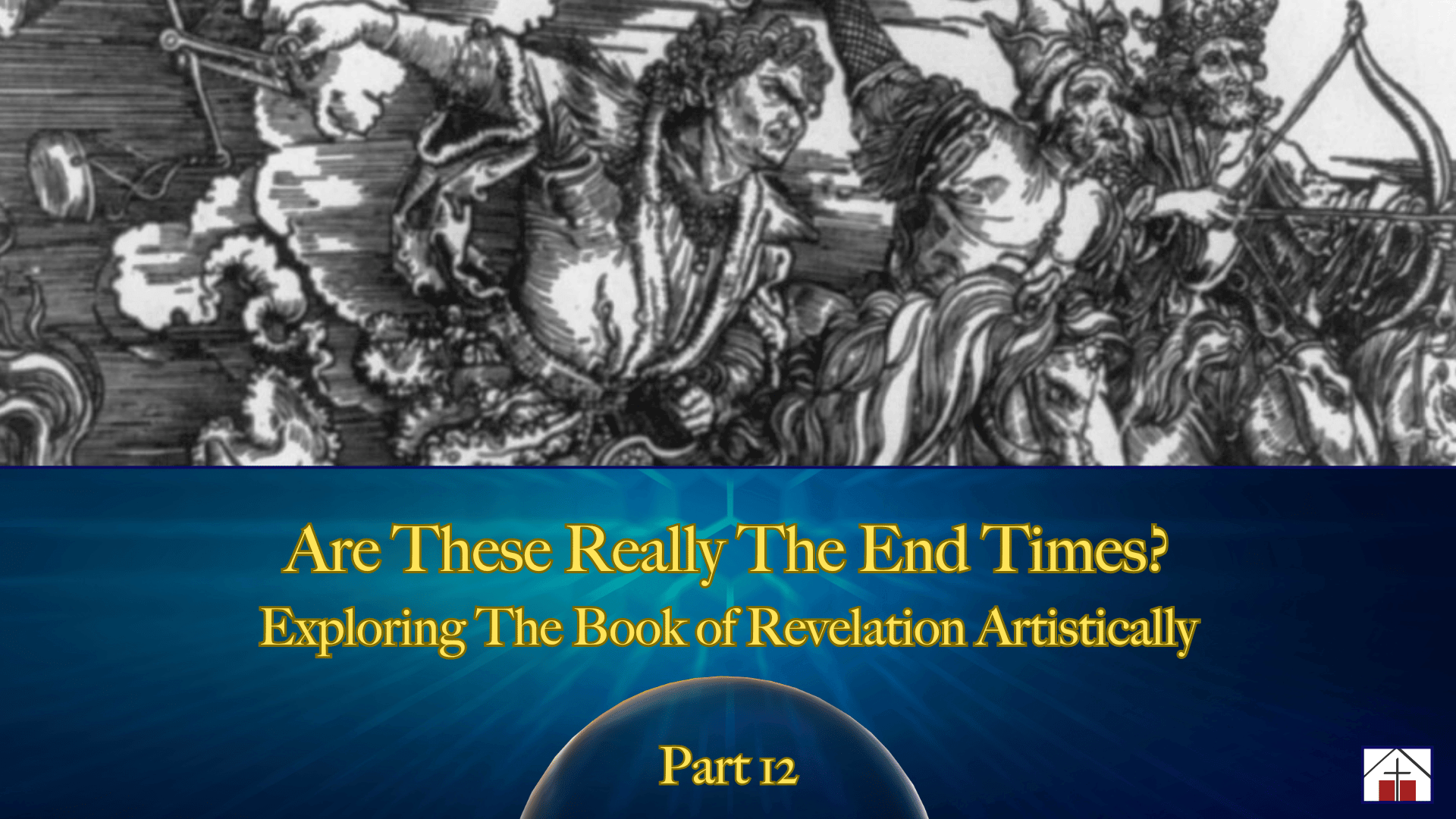
The First Six Seals (Revelation 6:1-17)
“As the Lamb opens each seal on the scroll that he received from God, the voice of one of the four living creatures who stand beside the throne shouts, ‘Come!’ In response, a series of four horsemen gallop before John’s eyes, warning of conquest, violence, hardship, and death. After the horsemen vanish, a vision of martyrs appears, followed by a specter of destruction and divine wrath that threatens all of humanity.”
“Readers do well to ask themselves what they expect from these visions. Many are fascinated with the seven seals because they think that the text issues predictions about a series of events that will occur in the future. They assume that if they can match the visions with events in the [news], they will be able to tell when the end of the world will come. According to this approach, we will know that we have arrived at the first seal when we see some world power embarking on the path of conquest. We will know when we have arrived at the second seal when the threat of violence spreads. As violence leads to economic hardship, we will find ourselves at the third seal, and so forth until God’s wrath is poured out and the kingdom of God arrives with the opening of the sixth and seventh seals.”
“’Prediction’ is not the right word for these visions, however, because they depict threats that do not fall neatly on a time line. Virtually everyone understands that the four horsemen have a symbolic or representative quality. We realize that the text is not telling us to expect the end times to begin when we see a solitary figure with a bow in his hand riding a white horse through the streets of our city, but recognize that the visions stand for larger realities. The text makes clear that the horsemen represent conquest, violence, economic hardship, and death. These were genuine threats for people in the first century and they have remained treats for people in subsequent centuries, which is why attempts to predict the onset of the end times on the basis of these visions have consistently failed. The dangers that they depict cannot be confined to any one period: waves of conquest, outbreaks of violence, and periods of economic hardship have occurred repeatedly in human history, and death finally comes to all.”
“The principal purpose of the visions in Revelation 6 is to awaken a sense of uneasiness in readers by vividly identifying threats to their well-being. The four horsemen are designed to shatter the illusion that people can find true security in the borders of a nation or empire, in a flourishing economy, or in their own health. Subsequent visions promise that God will not allow injustice to continue forever – which is assuring to the victims, but disturbing to the perpetrators – and warn that no place on earth and no position of power or wealth will protect people from the judgment of God and the Lamb. Those who grasp the way that these visions relentlessly undercut human pretensions will find themselves asking the final question in the chapter: ‘Who is able to stand?’ (6:17). Those who have been moved to ask this question are rightly prepared for the visions that follow in chapter 7.”
“The visions of the four horsemen have captured the imaginations of people for centuries, but certain aspects of the imagery would have been most apparent to people in the seven churches addressed by Revelation. The first horseman, who is armed with a bow, was an apt figure to represent conquest since horses were commonly used in warfare, and various armies had bowmen, some of whom belonged to the cavalry. The most famous mounted bowmen of John’s time, however, came from Parthia, the region that lay beyond the Roman Empire’s eastern frontier. The Parthian forces, which featured mounted archers, repeatedly drove back the Roman army in 53 B.C., 36 B.C., and A.D. 62, bringing Roman imperial expansion to a halt. The Parthians were a nagging reminder about the limits of the security that Rome – the region’s most powerful empire – could provide. The implication was that the Christians who partook of the sacrifices offered to the deified emperors and other Roman gods (2:14, 20) were compromising their convictions to placate powers that were not supreme, but vulnerable to invasion by outside forces. Those who were sure that they needed nothing more than the prosperity provided by the empire (3:17) were deluding themselves.”
“The second horseman, who wields a great sword, ‘was permitted to take peace from the earth, so that people would slaughter one another’ (6:4). Where the first rider represented the threats to security that come from outside one’s borders, the second rider stands for the threat of violence that can erupt within one’s own society. The vision is written in a way that disturbs one of the premier attitudes that the Romans tried to inculcate in people, namely, that the world should be grateful to them for providing peace. Orators were effusive in their praise of the Pax Romana or Roman Peace, lauding it as the source of unprecedented prosperity. As regional conflicts were contained, new roads were built and ships plied the seas. Merchants expanded commerce to include the glittering array of items mentioned later in Revelation: ‘cargo of gold, silver, jewels, and pearls, fine linen, purple, silk and scarlet, all kinds of scented wood, ivory, bronze and iron, spices, flour, livestock, and slaves’ (18:11-13). Many accepted the death of Antipas (2:13) and the oppressive steps taken against other Christians (2:10) as measures needed to preserve the peace. Yet, the second rider warns against being lulled into complacency by comfortable conditions that pass for peace (3:1), for such peace can be removed.”
“The third horseman holds a pair of scales, like those used in commerce, and issues a threat of economic hardship (6:5-6). The rider does not decree an utter famine, but speaks of wheat and barley being purchased at high prices, while oil and wine continue to be available. Nevertheless, these conditions would have been harsh on the poor. If a denarius was a day’s wage for a laborer, then it would cost an entire day’s pay to buy one quart of wheat or three quarts of barley. These quantities of grain might be enough to keep a small family alive, but there would be no money left to buy any oil or wine. The flourishing Roman economic system was celebrated for its ability to make grain and other foodstuffs widely available (18:13), but the specter of crop failures and food shortages -like those that periodically plagued Asia Minor and other places – is a vivid reminder about the limits of any economic system to guarantee prosperity.”
“The fourth horseman, who sits astride a sickly green horse, represents death (6:8). This rider holds nothing in his hands, but is followed by ‘Hades,’ the Greek name for the realm of death. Death’s tools include the violence that people perpetuate by the sword, the famines that break out due to crop failures and other causes, the diseases and plagues that rob people of health and life, and the wild beasts like wolves and hyenas, whose teeth tear the vulnerable (6:8). Thus, the specter of death heightens and expands the threats represented by the previous horsemen, hemming readers in with forces that ultimately reach beyond human control.”
“The opening of the fifth and sixth seals results in a jarring pair of scenes that challenge ordinary perceptions of peace and security: the martyrs rest in heaven (6:9-11) and the remainder of humanity is disturbed on earth (6:12-17).”
“When the mass of humanity finally cries out, ‘Who is able to stand?’ (6:17), readers might expect the answer to be ‘No one,’ for all seem doomed to destruction under God’s wrath. Yet that is in fact not the case, for the next chapter [Revelation 7] shows that there are some who are able to stand before God and the Lamb, not by their social position, but by grace.”
(Koester)
(Source: Craig R. Koester, Revelation and the End of All Things.)
For this week: For reflection:
- Read Revelation 20:1-10. “These verses speak of the overthrow of Satan and the glorious reign of Christ. During the rule of Christ, Satan will be powerless for a thousand years.”
(Source: The CEB [Common English Bible] Lectio Divina Prayer Bible.)
An invitation to our virtual participants: Discussion and comments are very much encouraged and welcomed. Online discussions can be held in the comments section in the upcoming post on Social Media for this week’s Deacon’s Reflection which is part of adult formation at St. Francis Episcopal Church.
Closing Prayer – Prayer of Blessing
The blessings of heaven, the blessings of earth, the blessings of sea and of sky. On those we love this day and on every human family, the gifts of heaven, the gifts of earth, the gifts of sea and of sky.
May the light of God illumine the heart of my soul.
May the flame of Christ kindle me to love.
May the fire of the Spirit free me to live this day, tonight, and forever. Amen.
- J. Philip Newell, Celtic Treasure – Songs of the Soul, p. 165.
“Are These Really The End Times? – Exploring The Book Of Revelation Artistically,” Deacon Joe Dzugan, St. Francis
Episcopal Church, 2025.
- J. Philip Newell, Celtic Treasure – Songs of the Soul, p. 165.