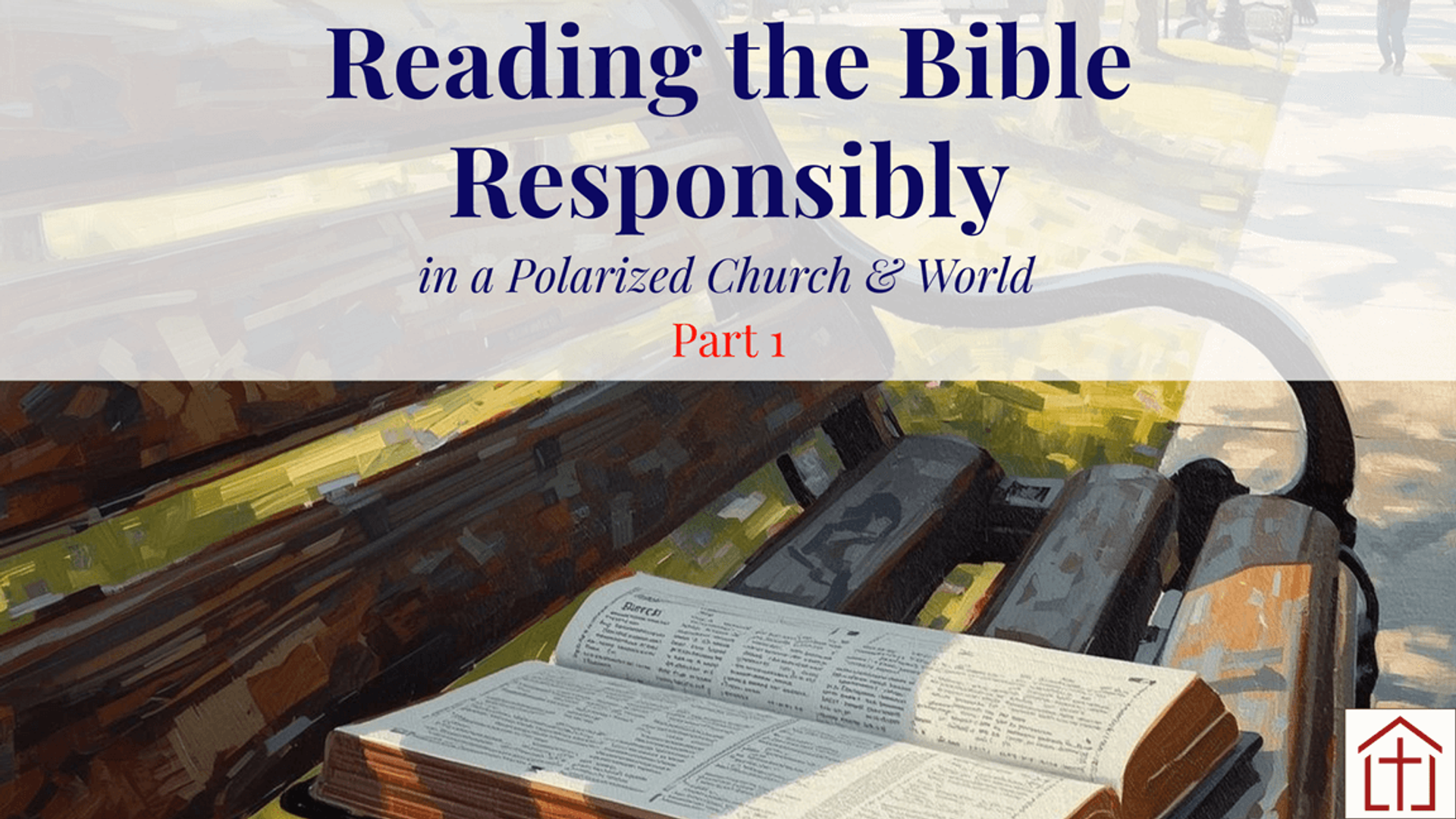
Reading the Bible Responsibly in a Polarized Church & World – Part 1
Opening Prayer
I watch this morning for the light that the darkness has not overcome. I watch for the fire that was in the beginning and that burns still in the brilliance of the rising sun. I watch for the glow of life that gleams in the growing earth and glistens in sea and sky. I watch for your light, O God, in the eyes of every living creature and in the ever-living flame of my own soul. If the grace of seeing were mine this day, I would glimpse you in all that lives. Grant me the grace of seeing this day. Grant me the grace of seeing.
- John Philip Newell, Celtic Benediction, p. 2.
Reading the Bible Responsibly in a Polarized Church & World:
The Bible’s content in many ways engages its readers – puzzling, angering, challenging, and inspiring them. How has the Bible historically been used, including with the issue of slavery? Can readers navigate the use of biblical texts that are quoted across the political spectrum? What principles exist for interpreting these texts that support conflicting viewpoints? Together, we will explore a way forward: reading the Bible with each other guided by the rule of love.
Introduction
For many of us, the Bible has been both a source of wisdom and a source of wounding. The Bible has inspired liberation and love, just as it has also been used to justify domination and division.
It is obvious that both American society in general and the American Church in particular suffer from a polarization of members around a number of pressing issues including such topics as: abortion, race, same-sex marriage, gender identity, immigration, climate change, the use of tax dollars for social safety nets such as welfare and health care, and the justification for military action.
As writer Brian McLaren shares (Center for Action and Contemplation Daily Meditations, January 5, 2026), “One of the weapons we see people use in our hostilities and fragmentation is the Bible. Many of us have been wounded by the Bible wielded as a weapon. Many of us have wielded the Bible as a weapon ourselves and wounded others. Many of us have stayed away from the Bible entirely because it feels like something dangerous – a sharpened weapon, a loaded gun, a ticking time bomb, a toxic recipe. . . But if we learn to read the Bible in conversation with our honest experience and in the light of our living traditions, we can learn and model a better way.”
It is the aim of these adult formation sessions over the upcoming weeks to focus our attention on how we read biblical texts, why we read them differently, and how to embrace the broader experience of individuals and people.
Language Matters
“’Sticks and stones may break my bones, but names will never hurt me.’ This nursery rhyme is often quoted by adults to children who have been teased or taunted by their peers. [The rhyme appears in print as far back as 1872.] The point of the saying seems to be that, because words are powerless to harm us (in comparison to weapons), we should disregard harmful words directed at us. However, the existence of the nursery rhyme itself may prove this very point to be false. The nursery rhyme functions as an act of protection against harmful words. This implies not only that there are words – such as name-calling - that can harm, but also that there are words with protective power – such as the nursery rhyme – that can shield us from harmful words. Indeed, children are known to respond to name-calling by reciting the nursery rhyme. This practice reveals that the saying’s purpose is not to declare that negative words are powerless. Instead, it is to deflect these negative words with more powerful words, rendering the attempt to harm meaningless.”
“Words have power, then, which we often overlook or take for granted. First and foremost, they give us the ability to make our internal thoughts, feelings, and desires available to others. They bring what is inside of us out into the open for others to know and share.”
“Words have power to change our lives and mark the changes in our lives. Every one of us can think of numerous times when we said something we wish we hadn’t, or didn’t say something we wish we had.”
“All words have power, but all are not equally powerful. Oaths and the words of the sacraments carry more weight than that of the nursery rhyme for most people. In many cases the source of the words, whether a speaker or a text or some combination of both, determines the weight given to those words. In other words, the context of words plays an important role in the authority those words are seen to have.” (Thomas M. Bolin, An Inspired Word in Season – Reading the Bible Responsibly in a Polarized World, 2025.)
For this week: For reflection: What is your concept of the authority of Scripture?
An invitation to our virtual participants: Discussion and comments are very much encouraged and welcomed. Online discussions can be held in the comments section in the upcoming post on Social Media for this week’s Deacon’s Reflection which is part of adult formation at St. Francis Episcopal Church.
Closing Prayer – Prayer of Blessing
May the light of God illumine the heart of my soul.
May the flame of Christ kindle me to love.
May the fire of the Spirit free me to live this day, tonight, and forever. Amen.
- John Philip Newell, Celtic Benediction, p. 5.
“Reading the Bible Responsibly in a Polarized Church & World,” Deacon Joe Dzugan, St. Francis Episcopal Church,
2026.